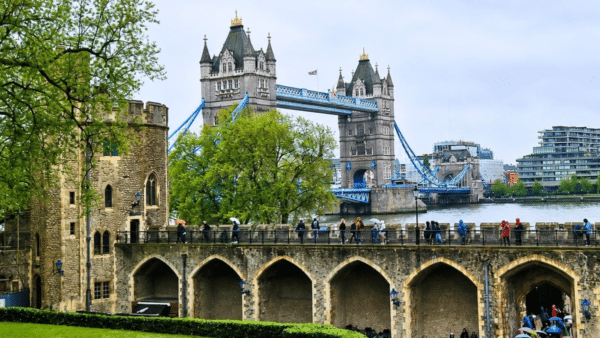
Seeing the Crown Jewels in London and Paris was one of the highlights of our trip — from the royal treasures at the Tower of London to the surprising story of the French Crown Jewels at the Louvre. I didn’t expect that the history behind those glittering displays would be just as fascinating as the jewels themselves and a little surprising.
Seeing the Crown Jewels at the Tower of London

Going to the Tower of London, a medieval castle, and seeing the Crown Jewels is truly a must-see experience. You enter through the ancient stone gates of the Tower (a fortress with several buildings) and follow a winding path past the Yeoman Warders (the ceremonial guards also called “Beefeaters”) before arriving at the Jewel House.
Pro Tip: Because the line gets longer through the day, the first thing you should do when you visit the Tower is head straight to the Crown Jewels area and get in line.
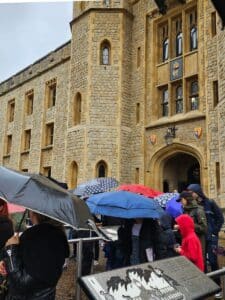
Our tickets for the Tower of London were for a morning entry so the line at the Jewel House wasn’t too long. Cameras aren’t allowed inside of the Jewel House, which actually makes it easier to take it all in without distraction.
When we finally reached the display, we were moved along by a conveyor walkway. The bright lights seem to make every gem glow — the Imperial State Crown, the sceptre, and the crowns used for coronations all glimmer behind glass and were really beautiful pieces.
I hadn’t realized before visiting that the crown jewels on display aren’t just museum pieces — the same crowns and sceptres that have been part of royal history for centuries are still used in royal ceremonies today — some we’ve seen on TV or in the news about royal events. Seeing them up close made that tradition feel very real.
Since we couldn’t take pictures, we picked up a book in the gift shop on the history of the Crown Jewels with beautiful photos for a souvenir.
Tour of the Louvre
A few days later in Paris, we took a semi-private tour of the Louvre. It was a Monday morning just after the museum opened, and even then, the museum was already starting to get busy with visitors.

If the Tower of London felt like a fortress of history, the Louvre felt like a palace — which, of course, it once was. Not everyone realizes that the Louvre started as a royal palace long before it became the world’s largest art museum. It’s enormous — spread across an area about the size of ten football fields.
Honestly, we were glad to be on a guided tour, because it would have been easy to get lost wandering its endless halls and grand staircases through the crowds of visitors.
We booked our semi-private Louvre tour through Viator and it was an excellent experience. (This post contains affiliate links. If you book through these links, I may earn a small commission at no extra cost to you — which helps support this blog!)
The French Crown Jewels at the Louvre
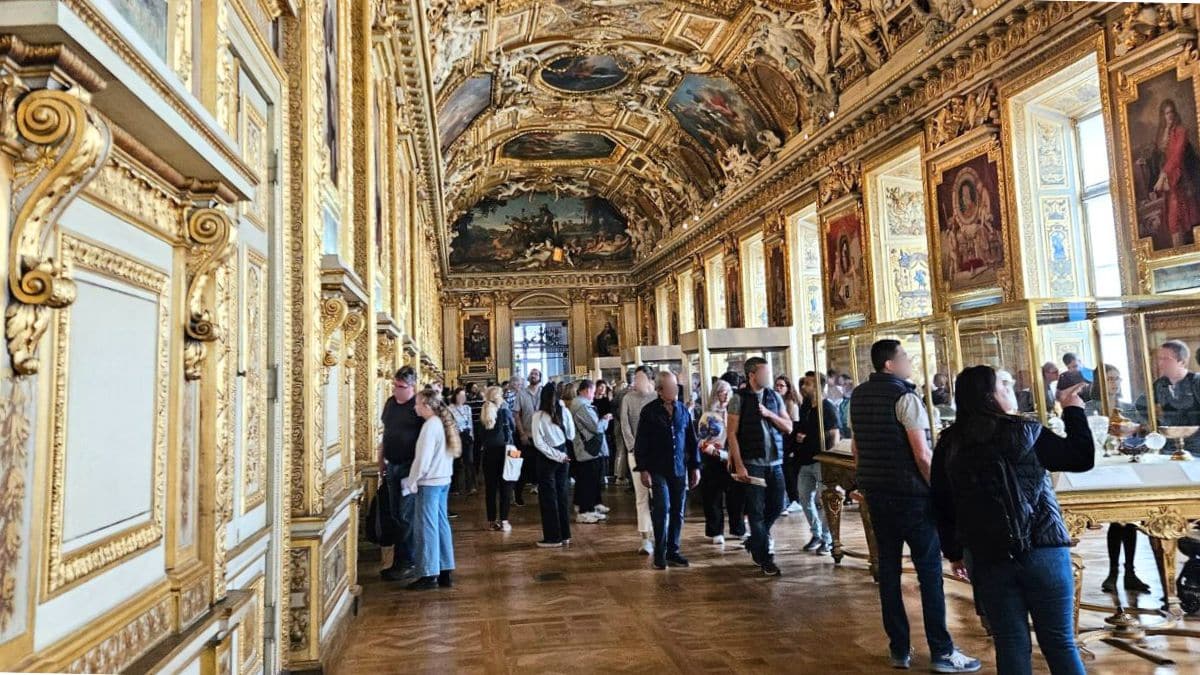
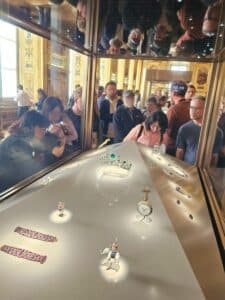
The French crown jewels are displayed in the Galerie d’Apollon, a long, elegant and grand hall filled with chandeliers, gold trim, and an elaborate painted ceiling. Unlike London, photography is allowed, so we took plenty of pictures to remember it.
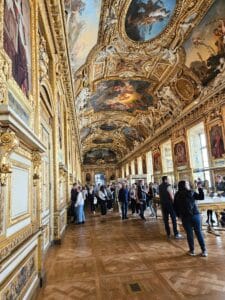
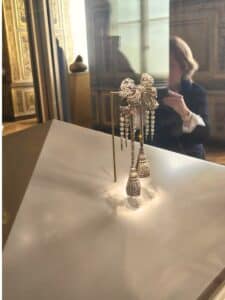
Our guide, Jean, really made this tour special — he was friendly, knowledgeable, and full of those small historical details that make a tour come alive. As we admired the jewels, he explained many of the French royal jewels were exact reproductions, beautifully crafted to represent pieces lost during the French Revolution.
He explained that after the Revolution, much of France’s royal jewelry was stolen, dismantled, or sold. Only a handful of authentic pieces survived, and those that did eventually became part of the museum’s collection. The reproductions were added later to help tell the full story — a history of power, loss, and artistry.
The Louvre Crown Jewels Heist
A year later, it was surprising to hear that thieves managed to steal eight priceless pieces from the Louvre’s Apollon Gallery — the very same room we visited. The theft took only minutes, yet the loss was enormous.
These weren’t replicas. Among the stolen items were jewels once worn by Empress Eugénie, the wife of Napoleon III, and Empress Marie-Louise, the second wife of Napoleon I.
Eugénie’s pearl and diamond tiara was said to sparkle with over 2,000 diamonds and more than 200 pearls. Another stolen piece, an emerald-and-diamond necklace originally belonging to Marie-Louise, was one of the most remarkable examples of French imperial jewelry ever created.
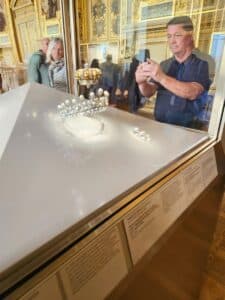
Those jewels weren’t just symbols of royalty — they were part of France’s history. Knowing we had stood in that same busy gallery a year earlier, in this palatial museum, it is really hard to believe.
Why This History Stuck With Me
When Jean told us that some of the French jewels were actually replicas, I was surprised at first — but then it made perfect sense. France’s royal history went through such upheaval during the Revolution that it’s amazing any of the jewels survived at all. What we see now is part real, part re-created, but all of it tells the story of that era. It made me realize that museums aren’t just about preserving what’s left — sometimes they’re about helping us imagine what once was.
If You Go: Visiting the Crown Jewels
Tower of London (UK)
- Buy tickets in advance and go early, especially on weekends.
- No photos are allowed inside the Jewel House, so take a moment to really look.
- The Yeoman Warder tours are a fun and informative way to start your visit.
The Louvre (France)
- The crown jewels are in the Galerie d’Apollon in the Denon Wing — the same wing as the Mona Lisa.
- A small-group or semi-private tour helps you navigate the vast museum and see some of the major works of art. We booked our semi-private Louvre tour through Viator.
- The Apollon Gallery alone is worth the visit — its ceiling is as breathtaking as the jewels themselves.
Questions about First-Time Travel to Europe?
For answers, visit my blog: Top Questions for First Trip to Europe (Answered!)
This post contains affiliate links. If you book through these links, I may earn a small commission at no extra cost to you — which helps support this blog!