Updated for 2026 travel
Planning your first trip to Europe is exciting – but it can also feel a little overwhelming.
From understanding new entry requirements like the EES border system and UK ETA, to figuring out phone service, packing, and getting around, there are a lot of details to think through before you go.
To make things easier, I’ve put together this guide with the most common questions for first-time travelers – along with answers, helpful tips, and a few great photo spots to make the most of your trip. Whether you’re just starting to plan or finalizing the details, this will help you feel more confident and prepared for your first European adventure.
New entry process: EES Border System & the UK ETA
For 2026 travel to Europe, there are new entry processes for travel to the Schengen Area (a border-free zone of 29 European countries that allows free movement for travelers and citizens) – and a new process for travel to the UK.
What is the EES Border System in Europe?
If it is your first trip to Europe there’s a new digital border control system called Entry/Exit System (EES) process that you’ll go through at passport control.
This new system replaces the old passport stamping process with a digital entry record.
What to expect at the airport
The first time you enter Europe – lines at the airport might be long due to the new process.
- You’ll scan your passport at a kiosk
- A machine will take your fingerprints and a photo
- Your entry is recorded digitally instead of stamped
- If there’s any issue, you may be sent to a manual passport control line for additional questions
Download the app before your trip
To save time, you can pre-register your information before your trip using the official Travel to Europe app.
Filling this out in advance can help speed things up when you arrive at the airport.
Traveling to the UK? You Now Need an ETA
If your Europe trip includes London or anywhere in the UK, there’s another new step: the UK Electronic Travel Authorisation (ETA).
This is required before you fly – you won’t be able to board your flight without an approved ETA
What is the UK ETA?
A quick online travel authorization (similar to TSA PreCheck or ESTA in the U.S.)
Costs about $10 USD Usually approved within a few days (often faster)
Valid for 2 years once approved
1.Do I need a visa to visit Europe?
No, for U.S. and Canadian travelers, you don’t need a visa for most European countries if you’re staying under 90 days. (You may need to apply for an ETIAS travel authorization online once it goes into effect, check for guidelines before traveling.)
Valid passport for at least six months!
Your passport must be valid for at least 6 months (beyond your travel dates) when you enter any EU country or the Schengen Area. Always double-check expiration dates before booking flights.
2.Where to stay in Europe: Tips for first-time travelers
Location matters! While public transportation is great in most cities, staying in hotels that are centrally located or close to public transit makes it easy to get to the main attractions, saves you time commuting and makes exploring more enjoyable.
(This post contains affiliate links. If you book through these links, I may earn a small commission at no extra cost to you – which helps support this blog!)
Tips on where to stay in London
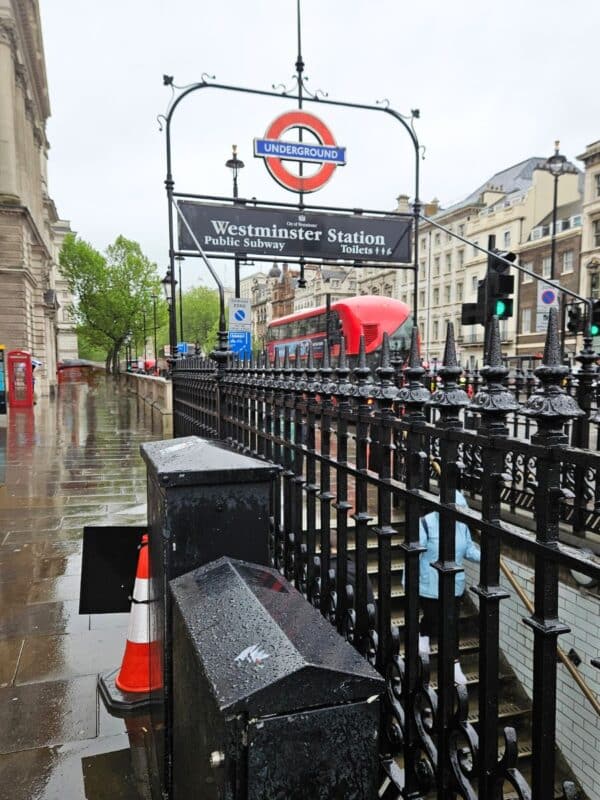
There are a lot of great areas and hotels in London. When we stayed in the Westminster area, it was so convenient to be in walking distance or a short ride to the classic sights like Big Ben, Westminster Abbey, the London Eye, and Trafalgar Square. You can also walk to the Thames and see the city lights at night.

Photo Spots in London:
- Classic red phone booth selfie with Big Ben in the background
- Westminster Bridge view of Parliament and Big Ben together
- Churchill Arms pub in Kensington (covered in flowers)
Tips on where to stay in Paris
When choosing where to stay in Paris – it helps to understand how the city is laid out before choosing the area you’d like to stay in. Paris is divided into 20 arrondissements (neighborhoods) that spiral from the center, with the Seine River splitting the city into the Left Bank (south) and the Right Bank (north).
When we stayed in Saint-Germain-des-Prés (6th arrondissement), it was about a 10-minute walk across the bridge to Notre Dame, Sainte-Chapelle, and the Louvre Museum, and a quick metro ride to the Eiffel Tower.
Photo tip: By being in walking distance to the Seine we were able to see some popular sites from the bridges and the city lights at night.

The Saint-Germain-des-Prés neighborhood is also known for its two world-famous cafés – Café de Flore and Les Deux Magots – that are just as fun for people-watching and snapping photos.
Pro Tip: For first-time visitors, the 5th–7th arrondissements are excellent areas to stay in – they’re central, scenic, and have easy access to public transportation.
3.Can I use my phone in Europe?
Yes, most major phone carriers work abroad (you may have to activate an international plan) – but be careful about roaming fees from your carrier. Instead you can also:
- Get an eSIM card like Holafly or Airalo for affordable local data. These give you local data coverage so you can use maps, social media, and messaging without roaming fees.
- Use Wi-Fi calling in hotels and cafes.
- Download WhatsApp to text and call family or friends for free over Wi-Fi.
Important: Most eSIMs are data-only. If you want to make a traditional long-distance call, you’ll need to switch back to your regular carrier plan temporarily.
Pro Tips:
- Install your eSIM before you leave home so it’s ready to activate on arrival.
- Bring a portable battery pack (carry-on only!) to keep your phone charged.
- Don’t forget a universal power adapter (bonus if it has USB-C).
4. Can I use the electrical outlets and plugs in Europe?
No, Europe uses different outlets than in the U.S. and 220V power. You’ll need:
- A universal power adapter (bring at least 2–3 if traveling as a couple or family).
- A voltage converter if bringing non-dual voltage items (like some hair dryers).
- A small travel power strip (hotel rooms often have limited outlets).
5. Can I bring a portable battery pack on the plane?
Yes, a portable charger/power bank keeps your phone charged during long sightseeing days.
- Battery packs must go in your carry-on – not checked luggage.
- The battery must not exceed 100 watt-hours (Wh) for most power banks.
- Check your airline’s rules for larger batteries.
6. Should I get cash in euros before I leave?
Not necessary. Most places accept credit or debit cards (especially in tourist areas).
- Use an ATM after you arrive for the best exchange rates.
- Always choose “charge in local currency,” not USD.
- Carry small bills and coins for bathrooms, markets, and metro tickets.
Don’t forget to notify your bank before traveling so your card doesn’t get declined.
7. How do I order food if I don’t speak the language?
Many restaurants in major European cities have staff who speak some English. Be polite and try a local greeting (“Bonjour,” “Buongiorno,” “Hola”).
- Use Google Translate to scan menus or learn key phrases.
- Don’t be afraid to point at the menu when ordering—it’s common!
8. What should I wear in Europe?
Dressing for comfort is important, but blending in and looking less like a tourist makes you less of a target for scammers and pick-pockets.
- Clothing: Neat, casual outfits (avoid sports jerseys, ball caps, and flashy logos).
- Shoes: Comfortable walking shoes. There are cobblestone streets and a lot of stairs. You do a lot of walking when you’re sightseeing (we walked almost 30,000 steps in one day in London!).
- Layers: Weather can change quickly — keep a scarf in your bag and pack a light jacket or sweater.
Check out this post: Packing Tips: Easy Capsule Wardrobe for Europe Travel
9. How do I get around in Europe?
- Trains: High-speed rail like Eurostar (London–Paris), SNCF (France), and Trenitalia (Italy) are excellent for city-to-city trips.
- Public Transit: Subways, trams, and buses are affordable and easy to use.
- Walking: Many European cities are walkable and easy to explore on foot – just wear comfortable shoes!
- Rideshares/Uber: Available in some cities, but not everywhere.
10. Do I need travel insurance?
While it’s not legally required to visit most European countries — travel insurance gives you peace of mind. It can cover medical emergencies, trip cancellations, or lost luggage. Shop plans on sites like SafetyWing or World Nomads.
We’ve used SafetyWing and it’s easy to sign up on their website in minutes. Coverage is good for 28 days then renews like a subscription or you can cancel.
11. How much should I tip in Europe?
Tipping customs vary by country, but generally tipping is not expected, as service staff are typically paid a living wage and often a service charge is already included in the bill.
- Restaurants: Round up or leave 5–10%.
- Taxis: Round up to the nearest euro.
- Hotels: A few euros for porters or housekeeping.
12. Can I drink the tap water?
In most of Western Europe, yes. France, Germany, Italy, and Spain all have safe tap water.
Tip: Restaurants often automatically serve sparkling bottled water so make sure you specify “still” water if you don’t want sparkling water.
In one of my first interactions in France, when I ordered a bottle of water – I was asked if I wanted water “with bubbles or still” and it took me a minute to figure out what the server meant.
13. How do I stay connected with family back home?
- WhatsApp, FaceTime, or Messenger for free calls and video chats.
- Share your location with family members on your phone.
- Group chats or Instagram updates for quick check-ins.
14. How do you tell time in Europe?
One small but important difference you’ll notice in Europe is the use of the 24-hour clock (also called “military time”). Instead of using AM and PM, times are written from 00:00 to 23:59.
For example:
- 1:00 PM = 13:00
- 6:30 PM = 18:30
- Midnight = 00:00
That photo of my alarm clock at 00:01? That’s actually 12:01 a.m. – just one minute past midnight!
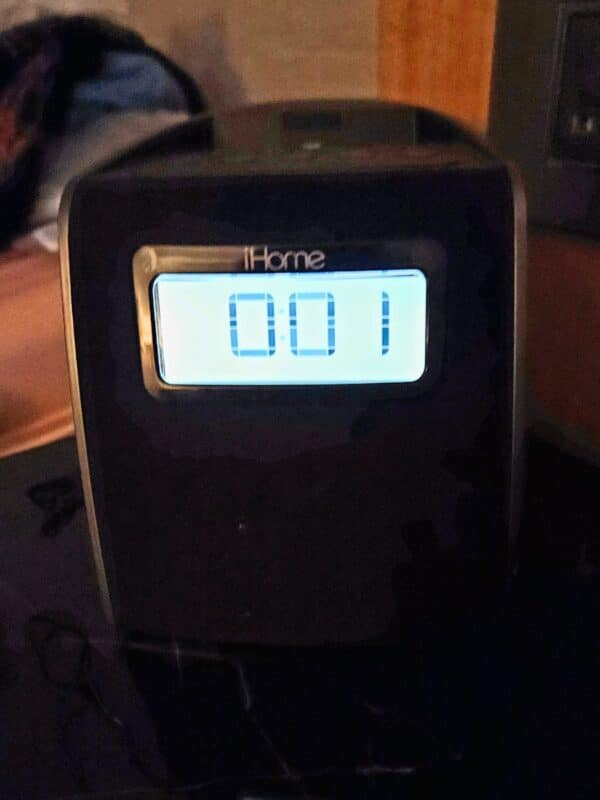
A simple trick is to subtract 12 from any time after 12:00 to convert it back to what you’re used to. For example: If 20:00 subtract 12 for 8:00 p.m.
You’ll see the 24-hour format on:
- Train schedules
- Flight times
- Hotel check-in details
- Restaurant reservations
Pro tip: Your phone will automatically adjust, and apps like Google Maps make it easy to follow times without thinking twice.
Bon voyage!
Traveling to Europe for the first time can feel intimidating – but it doesn’t have to be. With the right prep, you’ll avoid common mistakes and your trip will go smoother. Whether you’re taking a red phone booth selfie in London or sipping coffee at a cafe in Paris, your first Europe trip is one you’ll never forget.